English| EUR
Suggested for you
More currencies
Choose a language
Most visitors watch the hourly procession for forty seconds and leave without knowing what they saw. The Orloj is not one clock but three instruments stacked on a single wall, each measuring a different idea of time. This page sets out what the dials record, what the figures represent, and how the machine fits into a visit to Old Town Hall.
Quick answer
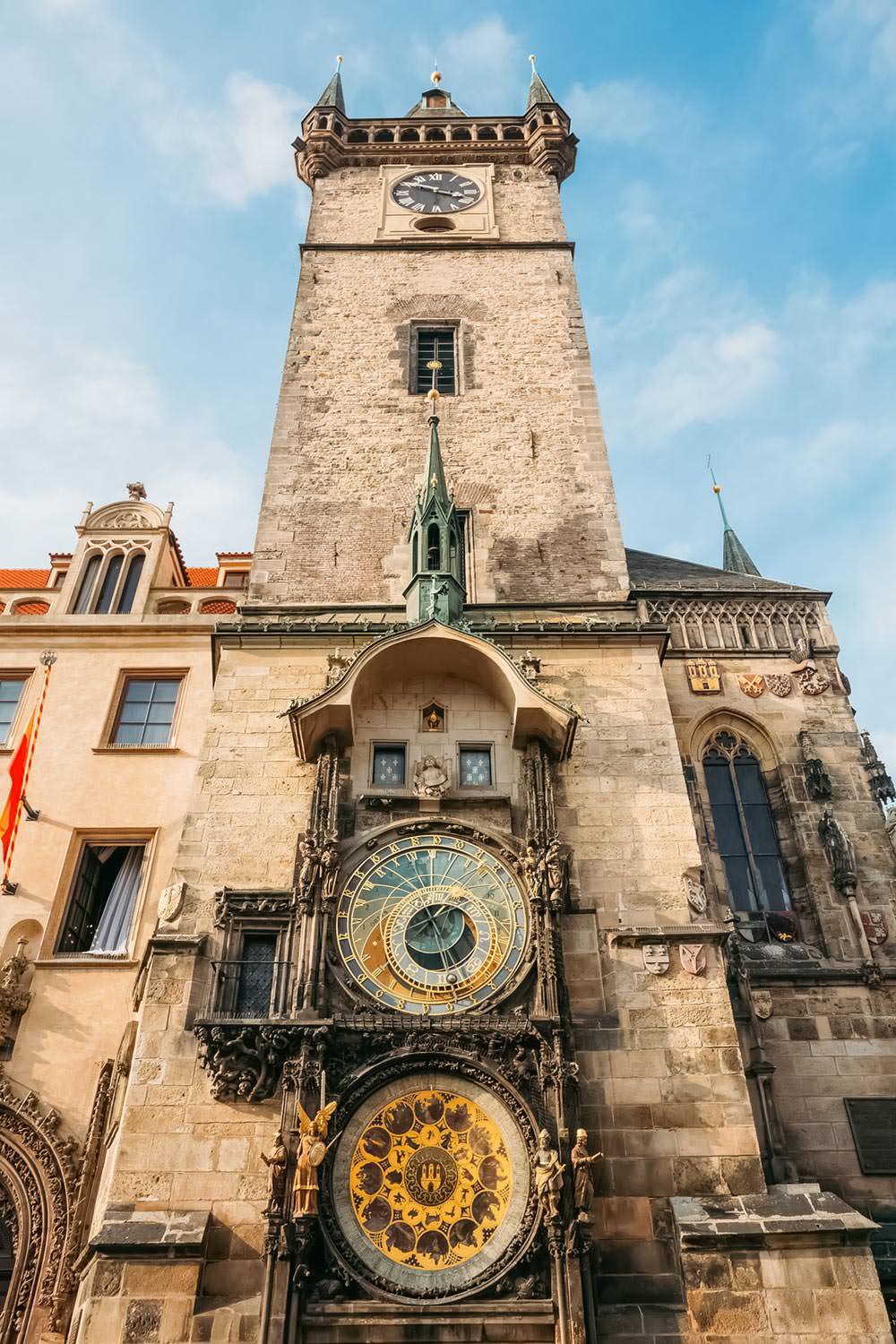
The Prague Astronomical Clock is a medieval instrument on the south wall of Old Town Hall at Staroměstské náměstí 1, combining an astronomical dial, a calendar dial and a set of moving figures. The upper dial tracks the sun, moon and zodiac against a stylised earth. The Apostles appear on the hour, roughly forty-five seconds of movement — a short show, so arrive early.
The clock does not tell one time. It tells four. The upper dial carries Central European time on its outer Roman numerals, Old Bohemian time on a rotating golden ring that resets at sunset, Babylonian hours that stretch and shrink with the seasons, and sidereal time measured against the stars. That is why the prague astronomical clock explained properly takes longer than the procession itself, and why the crowd on the square usually disperses before understanding what it just watched. The machine reads outward from the centre. A stylised earth sits at the middle, ringed by the blue disc of the visible sky and the black of night below the horizon line. A golden sun-hand sweeps across it; a moon sphere, half silvered and half black, rotates to show the lunar phase. Around the outside runs the zodiac ring, which the sun-hand crosses as the year turns. Below, the calendar dial is a separate instrument: a wheel of twelve painted medallions showing the labours of the months, restored from the panels Josef Mánes painted in the nineteenth century. Flanking both dials are the carved allegories — Vanity with a mirror, Greed with a purse, Death with an hourglass, the Turk with a mandolin — and above them the two windows where the Walk of the Apostles passes. Death pulls the bell rope. The others shake their heads. A golden rooster crows at the end. The Old Town Hall tower rises behind all of it, offering the rooftop view of Old Town Square and Týn Church that most Prague landmarks itineraries build around. The practical consequence is timing. The procession runs on the hour and lasts under a minute, so a visitor who wants the figures, the calendar dial and the tower needs to arrive with margin rather than at 10:59. Guided walks and any Prague Old Town tour tend to stack their groups at the top of each hour; the square empties again by ten past. Reading the dials is easiest in the quiet between shows, standing close enough to see the zodiac symbols and the Bohemian ring. Anyone treating this page as a prague astronomical clock explained guide should pair it with the hours, pricing and best-time sections on this site before booking a tower slot — the mechanism rewards a visit planned around the clock rather than one that merely arrives at it.
“The Orloj is not one clock but three instruments stacked on a single wall, each measuring a different idea of time.”
The Old Town Hall tower maintains a consistent weekly schedule, providing access to the astronomical clock and surrounding viewing areas.
Admission to the Old Town Hall tower is based on a standard adult fee. This cost provides access to the tower for viewing the clock mechanism and the surrounding city.
Verdict: A typical adult pays 350 CZK for tower admission, with the final cost increasing if an elevator supplement is required.
The best arrival window is 09:00–10:30, which allows visitors to experience the site before peak afternoon density accumulates in Old Town Square. Prioritizing these early morning hours ensures a more structured visit while avoiding the highest tourist traffic.
—
Quiet conditions allow for better observation of the clock mechanics and tower access.
Mild, 10°C to 16°C
These shoulder months avoid the intensity of mid-summer heat and peak vacation volumes.
Cold, 0°C to 4°C
Visitors encounter fewer crowds, though heavy coats are required for the open-air tower viewing platform.
Verdict: Tuesday to Thursday, arriving at 09:00, during the months of April or October provides the most favorable balance of crowd density and weather.
The Old Town Hall received its clock in 1410. Two men built it: Mikuláš of Kadaň, a clockmaker, and Jan Šindel, professor of mathematics and astronomy at Charles University. Šindel supplied the astronomical reasoning; Mikuláš cut the wheels. The oldest components — the mechanism and the astrolabe dial — still occupy the south wall of the tower on Staroměstské náměstí. This is the layer of the orloj that answers most directly when the prague astronomical clock explained is the question a visitor arrives with. Around 1490 the calendar dial was added and the Gothic stonework carved, work long attributed to Hanuš of Růže. The attribution is a later error, corrected by archival research in 1961; Hanuš, properly Jan Růže, maintained the clock rather than built it. The legend that the councillors blinded him to prevent a rival commission belongs to the nineteenth century, not the fifteenth. In 1552 Jan Táborský repaired the mechanism and wrote a report on it — the earliest surviving technical description. The apostles are comparatively recent. The procession of figures above the dials was installed in 1865–1866, during a restoration by Josef Mánes, who also painted the calendar plate; his original is held by the City of Prague Museum, and a copy by Bohumír Číla stands in its place. On 8 May 1945, retreating German artillery set the Town Hall alight. The wooden apostles burned, the dials were scorched, and the east wing was lost. Vojtěch Sucharda carved replacements, and the orloj restarted in 1948. A further overhaul in 2018 returned the calendar and astrolabe dials to their 1860s appearance and stripped away later concrete. Visitors to the tower today see the medieval gearing behind glass, the Sucharda apostles in motion each hour, and the scorched masonry that dates the 1945 fire — the surviving evidence behind any account of the prague astronomical clock explained.
Mikuláš of Kadaň and Jan Šindel complete the mechanism and astrolabe dial.
The calendar dial and Gothic stone surround are added to the tower face.
Jan Táborský repairs the clock and writes the oldest surviving description of it.
Josef Mánes paints the calendar plate and the apostle figures are installed.
Fire during the Prague Uprising destroys the apostles and the Town Hall's east wing.
Vojtěch Sucharda's carved replacement apostles are fitted and the orloj runs again.
A full restoration returns both dials to their nineteenth-century appearance.
The Prague Astronomical Clock operates through a complex assembly of mechanical components designed to track celestial movements and mark the passage of time. Beyond its function as a timepiece, the device serves as a medieval calendar and a showcase of early automation.
The clock consists of the astronomical dial, the calendar dial, and the procession of the Apostles. Each component performs a distinct function, ranging from tracking the sun and moon to signaling the hour.
This feature displays the position of the sun and moon in the sky, representing the earth at the center of the universe. It tracks multiple types of time, including Old Bohemian, Babylonian, and Central European time.
Every hour, the clock activates a mechanism that triggers the appearance of the Twelve Apostles through two small windows above the dial. This sequence is accompanied by the movement of several figures representing human vices and virtues.
Located below the astronomical dial, this section was added in 1865 to display the current date and the names of saints. It features medallions that correspond to the zodiac signs and agricultural tasks for each month.
The clock is composed of thousands of parts, including intricate gears, levers, and chains. These components have been maintained and restored over centuries to ensure the continuous operation of the clock's movements.
Everything you need to know about prague astronomical clock explained
The mechanism tracks solar, lunar, and zodiac cycles through a complex set of gears dating back to the medieval period. Understanding the prague astronomical clock explained requires observing both the main dial and the smaller calendar plate.
This landmark serves as a prime example of medieval engineering and Bohemian craftsmanship within the Old Town Hall. Seeking a prague astronomical clock explained tour provides deeper context on its symbolic figures and hourly processions.
The best arrival window is 09:00–10:30 to avoid peak afternoon crowds. Visiting during these hours ensures you experience the prague astronomical clock explained without navigating dense tourist throngs.
Regular adult admission to the tower is 350 CZK. This fee for the Old Town Hall includes access to the tower, though it excludes any additional elevator supplements for the Prague astronomical clock explained site.
Families are welcome to visit the tower to view the medieval machinery and city vistas. Seeing the prague astronomical clock explained in person is often a highlight for children interested in gears and history.
Yes, the original mechanical core continues to operate, moving the calendar and astronomical dials as it has for centuries. Maintenance teams ensure the prague astronomical clock explained remains fully functional for public viewing.
Prague Astronomical Clock Ticket Prices
Read more Tickets & toursHow to Book Prague Astronomical Clock Tickets Online
Read more GuideHow Does the Prague Astronomical Clock Work
Read more GuidePrague Astronomical Clock Performance Times
Read more Tickets & toursPrague Astronomical Clock Tower Tickets
Read more Tickets & toursPrague Astronomical Clock Guided Tours
Read more