English| EUR
Suggested for you
More currencies
Choose a language
Three faces stacked on one wall of the Old Town Hall do three different jobs, and most visitors watch the wrong one. This how does the Prague Astronomical Clock work guide separates the astronomical dial from the calendar dial and the hourly procession above them. It also covers the practical part: when to arrive at Staroměstské náměstí 1/3 so the view is not four rows of raised phones.
Quick answer
The Prague Orloj runs on a single geared movement driving three displays: an upper astronomical dial tracking the sun, moon and zodiac, a lower calendar dial turning once a year, and the hourly Walk of the Apostles. The procession runs on the hour only, roughly 09:00 to 23:00, and lasts under a minute — arrive at 09:00–11:00 to see it without crowds.
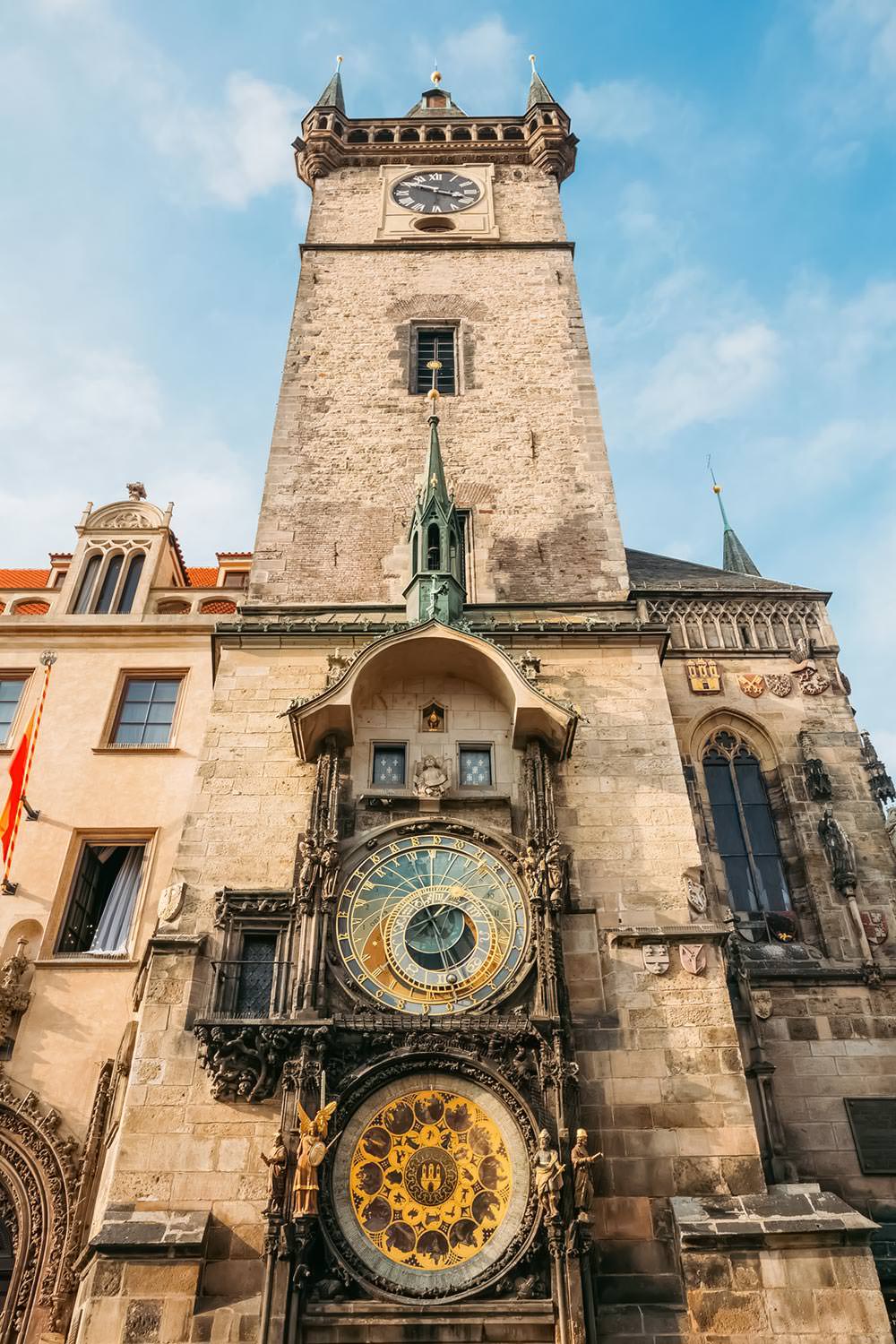
The clock keeps four different kinds of time at once, and none of them is the time on a phone. The large upper dial shows Old Bohemian hours, Babylonian hours, Central European time and sidereal time simultaneously, using a single set of hands and a rotating background of Roman and Arabic numerals. Understanding how does the Prague Astronomical Clock work begins with accepting that the golden hand is not a clock hand in the modern sense — it is a miniature sun, dragged around a stylised sky. The blue disc at the centre is the earth, the blue arc above it daylight, the black band below it night. A second hand carries a half-silvered sphere that rotates to show the lunar phase, while the zodiac ring drifts against both. The lower dial, painted by Josef Mánes in the nineteenth century, is a calendarium: twelve medallions of rural labour, turning one notch a day. The medieval mechanism behind them was built in 1410 by clockmaker Mikuláš of Kadaň with astronomical calculations by Jan Šindel — a detail the dedicated history section unpacks in full. Restoration in 2018 returned much of the movement to hand-forged components. What visitors actually queue for is the animation. On the hour, Death pulls his rope, two shuttered windows open, and the twelve Apostles pass behind them in pairs while three companion figures — Vanity, Greed and the Turk — shake their heads. A cockerel crows, the bell strikes, and the entire performance is over in under a minute. This is the moment the square compresses, and it is the reason any answer to how does the Prague Astronomical Clock work has to include a standing strategy alongside the mechanics. The practical use of this knowledge is simple. Watching the procession costs nothing and happens on the exterior south wall, visible from the open square. Going inside the Old Town Hall is a separate decision: the tower gives elevated views over Staré Město, and the interiors and chapel let you see the movement's housing from behind. Among Prague landmarks this is the one where five minutes of preparation changes the experience most. Read the dials first from a few metres back, near the Kinský Palace side of the square, then close in before the hour. A Prague Old Town walking tour will cover the same wall, but at someone else's pace — a self-guided reading of the orloj pražský lets you linger over the calendarium, which almost no group stops for.
“The golden hand is not a clock hand in the modern sense — it is a miniature sun, dragged around a stylised sky.”
The Prague Astronomical Clock is a complex assembly of mechanical components dating back to the 15th century. It operates through three primary systems working in synchrony to track time and celestial bodies.
This dial functions as an astrolabe, displaying the position of the sun and moon in the sky relative to the zodiac ring and multiple time systems. It tracks Old Czech, Babylonian, and Central European time simultaneously.
Located below the astronomical dial, this section features a rotating wheel painted by Josef Mánes in 1866. It indicates the current day, month, and agricultural labor cycles associated with each season.
Every hour, a mechanical procession occurs where wooden figures of the twelve Apostles pass two windows. This sequence is triggered by a specialized mechanism connected to the main clockwork.
The golden sun pointer moves across the zodiac circle to show the sun's position, while a separate sphere indicates the current phase of the moon. These movements rely on a gear system designed to replicate celestial orbits.
The outer ring represents the zodiac constellations, which rotate behind the sun pointer. This allows the clock to show the sun's progress through the ecliptic throughout the year.
The clock relies on an intricate set of gears and weights to maintain its cycle. These parts have been maintained and repaired for centuries to ensure the continuous operation of the dial and the hourly procession.
The oldest parts of the Orloj date to 1410, when the clockmaker Mikuláš of Kadaň built the astronomical dial in collaboration with Jan Šindel, a mathematics professor at Charles University. Wenceslas IV sat on the Bohemian throne. The mechanism was fixed to the southern wall of the Old Town Hall, a building the burghers had acquired in 1338 after King John of Luxembourg granted Prague's Old Town the right to its own council seat. Anyone asking how does the prague astronomical clock work is really asking about a device assembled before Gutenberg printed a page. Around 1490 the master Jan Růže, called Hanuš, repaired and extended the clock; a later legend held that the councillors blinded him so he could never repeat his work, and that he crippled the machine in revenge. Archival research in the nineteenth century disproved it. Alois Jirásek nevertheless retold the tale in his Old Czech Legends, and guides on any Prague landmarks walking tour still recite it beneath the dial. The calendar plate below the astronomical dial was painted by Josef Mánes in 1866, its twelve roundels of rural labour now held by the City of Prague Museum; a copy hangs in its place. The clock fell silent for long stretches — most of the seventeenth and eighteenth centuries — before Jan Táborský's 1552 report and later restorations revived it. On 8 May 1945 retreating German forces shelled the Old Town Hall; the eastern wing burned, the wooden Apostles were destroyed, and the dial was scorched. Vojtěch Sucharda carved replacement figures by 1948. A 2017–2018 restoration returned the tower to its 1860s appearance. Visitors to Staroměstské náměstí 1/3 see that layered repair history directly: fire-marked stone, Sucharda's Apostles, and a facsimile calendar — which is much of how does the prague astronomical clock work as a surviving object rather than a museum piece.
Prague's Old Town receives the right to a council seat and acquires the house that becomes the Old Town Hall.
Mikuláš of Kadaň builds the astronomical dial with input from the scholar Jan Šindel.
Master Jan Růže, known as Hanuš, repairs and extends the clock, later attracting the blinding legend.
Jan Táborský documents the mechanism and undertakes repairs after long periods of neglect.
Josef Mánes paints the calendar plate, its original later moved to the City of Prague Museum.
German shelling on 8 May burns the Old Town Hall's eastern wing and destroys the wooden Apostles.
Vojtěch Sucharda completes carved replacement figures for the Apostle procession.
A full restoration returns the tower and dial to their 1860s appearance.
This plan suits first-time visitors who want to see the hourly show from the square before going inside Old Town Hall, and runs roughly two and a half hours end to end.
Reach Staroměstské náměstí 1/3 in the 09:00–11:00 arrival window, before tour groups fill the space in front of the clock face. Walk the square once to get your bearings.
Stand slightly to the right of the clock rather than directly beneath it, so the Walk of the Apostles in the upper windows stays in view. Crowds thicken about ten minutes before each hour.
The performance lasts under a minute, ending with the trumpeter in the tower gallery above. Stay put afterwards while the crowd disperses toward Karlova.
Head to the entrance on the south side and allow 10–20 minutes of queueing at this hour. Adult entry is 300 CZK and includes the historic interiors.
Work through the Gothic chapel, the council chambers and the Romanesque and Gothic cellars beneath the building. Budget about 40 minutes at an unhurried pace.
A glass lift runs up the spiral core to the viewing gallery, with stairs as an alternative. Allow 25 minutes for the ascent, a full circuit of the balcony and the wait to come down.
From the top you can trace Týn Church, St Nicholas and the roofline toward Prague Castle. Time your descent before the next hourly crowd re-forms below.
The Old Town Hall, which houses the Astronomical Clock, welcomes visitors throughout the week with varying opening times on Mondays. Please consult the schedule below to plan your visit to the tower and historic interiors.
The best arrival window is 09:00–11:00 to avoid peak midday crowds and the heavy volume of visitors surrounding the hourly clock shows. Planning your visit during this period ensures a more manageable experience at the Old Town Hall.
—
Arriving at 09:00 provides the clearest access to the site before tour groups assemble for the hourly display.
Mild, 10°C to 16°C
These shoulder months offer temperate weather conditions and lower visitor numbers compared to the summer peak.
Warm, 18°C to 25°C
Tourist volume is at its highest, making early morning arrivals essential for navigating the area.
Verdict: The concrete best slot is Tuesday to Thursday between 09:00 and 11:00 during the months of April or October.
Everything you need to know about how does the prague astronomical clock work
The device operates using a complex set of gears to track the position of the sun and moon against the zodiac, which explains how does the prague astronomical clock work on a foundational level. It displays Babylonian, Old Bohemian, and standard Central European time simultaneously through its intricate dials.
The movement relies on a 15th-century mechanical system that drives multiple hands and rotating rings. Understanding how does the prague astronomical clock work involves recognizing that it is an astronomical dial, not just a standard timepiece.
While the main mechanism is enclosed, visitors can learn about the history of the device by touring the interior of the Old Town Hall. You can purchase tickets to explore the historic interiors and the tower, which provides access to see the clock's mounting from inside.
It tracks solar and lunar cycles, meaning it shows the moon's phase and the sun's position throughout the day. This illustrates how does the prague astronomical clock work as a historical model of the universe as it was understood in the Middle Ages.
To avoid peak crowds and long queues for the hourly show, the best arrival window is 09:00–11:00. Arriving during this period helps you manage your visit effectively before the largest groups assemble.
Visitors use their ticket to enter the tower, providing a vantage point over the square. You can discover how does the prague astronomical clock work by reviewing historical displays inside the building before heading up the tower.
Each hour, the procession of the Twelve Apostles appears in the upper windows while the skeleton figure tolls the bell. This performance is a centerpiece for tourists gathering in the square to watch the historic automaton.
Unlike modern quartz watches, this device tracks celestial movements and multiple calendar systems. It remains a masterpiece of medieval engineering that functions as both a calendar and a visual representation of the heavens.
Prague Astronomical Clock Ticket Prices
Read more Tickets & toursHow to Book Prague Astronomical Clock Tickets Online
Read more GuidePrague Astronomical Clock Explained: History and Design
Read more GuidePrague Astronomical Clock Performance Times
Read more Tickets & toursPrague Astronomical Clock Tower Tickets
Read more Tickets & toursPrague Astronomical Clock Guided Tours
Read more